The problem addressed is the diversification of international students and their reasons for applying at the Faculty of Arts and Social Sciences (hereafter: FASoS). As of now, the student population consists of 79% international students – with the largest three student populations constituting of German, Belgian and French nationalities. The diversity offices mainly focus on increasing cooperation between students who differ from each other. As the population of FASoS is so culturally diverse, the diversity offices’ policy is of significant importance here.
The diversity office’s core element focusing on this specific issue is the value of fostering cultural change. In short, this concerns attracting and retaining employees and students. Our surveys have found that indeed, internationalization plays a significant role in attracting (prospective) students. In itself, this core objective would thus lead to more diversity among the student population. However, the group of international students at FASoS is considerably homogenous (with 33.3% of respondents opting for ‘German citizenship’, 15.1& opting for ‘Belgian’ and 11.8% opting for ‘French’). With such a homogenous group, the core essence of the policy ambition of fostering cultural change is lacking: the policy ambition aims for creating cooperation between different students. However, with such a large homogenous groups, this effect is diminished.
The current policy is equally homogenous: the different programs are marketed in similar ways and more frequently in areas closer to Maastricht University. Virtual open days are organized to attract students not able to come to fairs closer to their region. However, prospective students might consider these approaches to be less personal, which could limit their reasons for application as no personal connection has been made. It should be noted that it is indeed hard to reach those who do not know about Maastricht University, as well as it is being hard to establish a connection from remote locations. One commonality is the international character and its importance for (prospective) students: regardless of nationality, the international character ranked high in reasons for applying at UM. However, to diversify the international student population and to foster cultural change and the attraction of talent, we propose the following policy changes:
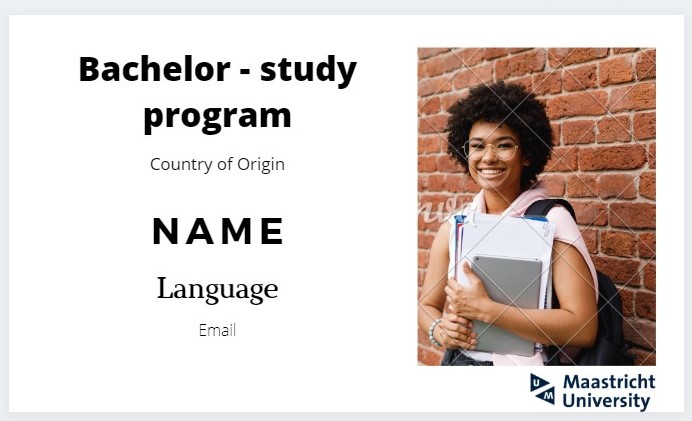
- We suggest to change the current student recruitment policy to target students from different nationalities, as such to attract a more diverse student population. FASoS offers interesting, international and innovative programs based on the relevant global needs. As such, combined with the importance of internationalization, student recruitment from other nationalities should increase the interest from these programs. Examples to enforce this policy could be the introduction of specific ‘country ambassadors’ for each FASoS program, that could engage with prospective students (online and offline) in their own language and familiar with their cultural customs. Moreover, FASoS could promote the different nationalities on their website and social media more to engage with prospective students who might consider applying. As internationalization is such an important factor, this could be emphasized in the promotion.
This could look similar to this…
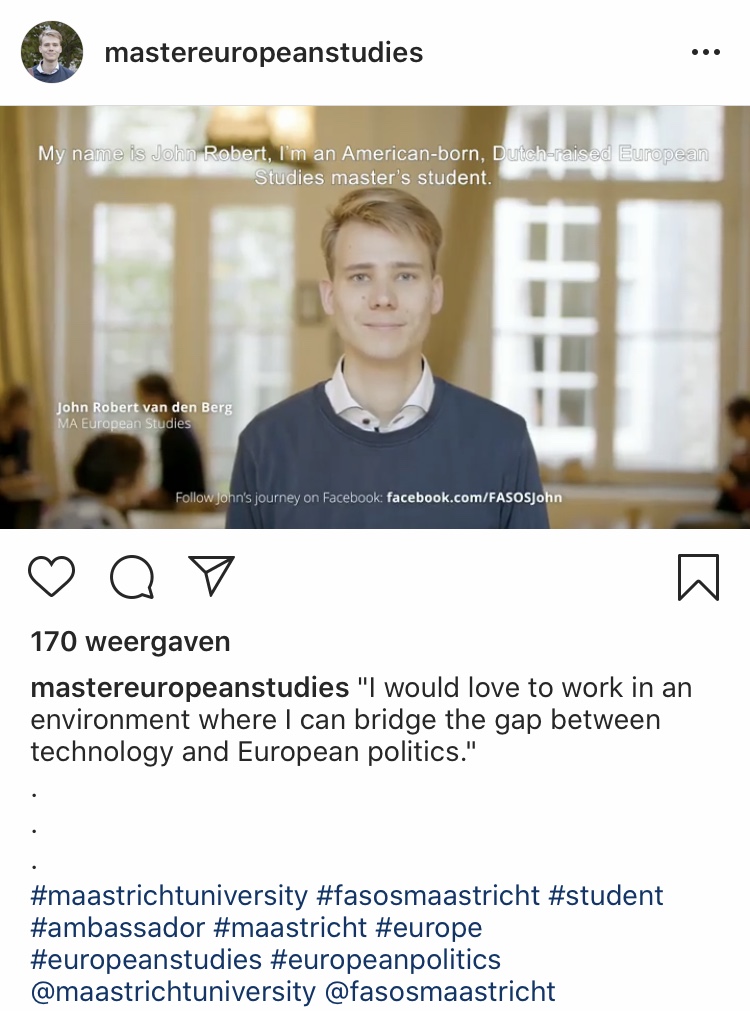
- We suggest an increased use of the FASoS social media channels (Facebook, Youtube, Instagram, TikTok, Snapchat) to engage with hard-to-reach target populations. The FASoS social media accounts have great potential if used correctly and could target specific students by hosting virtual events in the target language. Often, prospective students find it daunting to travel for open days as well as speaking in a new (foreign) language. If students can connect to the person behind the screen, they are often inclined to have a more personal connection and positive connotation to the brand they represent. This would be done by expanding the current social media, as well as creating new social media for the BAs where different ambassadors take turns in ‘live sessions’.
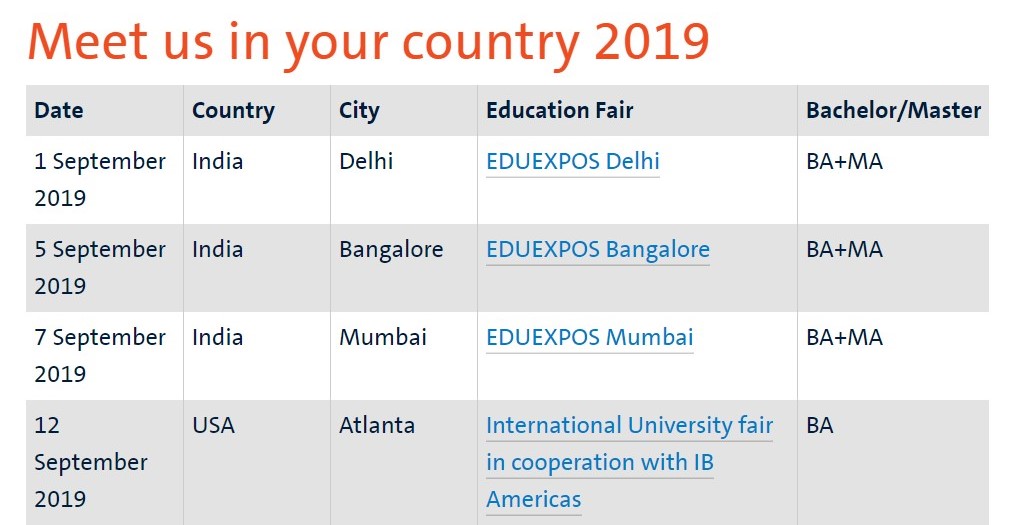
- We suggest an increased amount of study-fair related travelling to specific target countries. Fairs could be focused on EU-studies or study-abroad, as well as larger school visits. These visits would cost more, but as it gives UM a direct change to promote the internationality of the University through personal contacts, it could allow for a more diverse student population through more diverse student recruitment. This could be done by introducing a ‘meet us in your own country calendar’ on the FASoS website.
As UM and FASoS continue to expand and cater to the increasing demands of the world, they need to reconsider its marketing strategies to ‘difficult to reach’ nationalities, as to foster the continuing growth of the diverse international student population at FASoS. This would foster cultural change, whilst also attracting and retaining talent.
 Internationalization at FASoS